Cyrano De Bergerac Listening Activities and Reading Activities

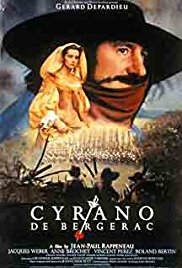
CYRANO DE BERGERAC
SUBJECTS — Drama/France; World/French republic;
SOCIAL-EMOTIONAL LEARNING — Romantic Relationships; Self-esteem;
MORAL-ETHICAL EMPHASIS — Respect.
Historic period; 10+; MPAA Rating — PG; Drama; 1990; 138 minutes; Color;
Available from Amazon.com .
THE All-time OF TWM
One of the All-time! This movie is on TWM'due south listing of the all-time movies to supplement classes in Drama, High School Level.

MENU
Motion picture WORKSHEETS & STUDENT HANDOUTS
For French or English Language Arts classes, distribute TWM's Film Study Worksheet . Teachers tin can modify the worksheet to fit the needs of each course. Enquire students to make full out the worksheet as they watch the movie or at the moving picture's end.
Description
This is an outstanding film version of the classic play. Cyrano de Bergerac is one of the most fascinating and contradictory literary characters of all time. He is both bombastic and timid; ugly and beautiful; dauntless and cowardly; poet and swordsman.
SELECTED AWARDS & CAST
Awards:
1990 University Awards: All-time Costume Design; 1991 British Lodge of Cinematographers: All-time Cinematography; 1990 Cannes Film Festival: Best Histrion (Depardieu); Technical Grand Prize; 1991 Golden Globe Awards: Best Foreign Film; 1991 European Picture show Awards: Best Production Design; 1990 Cesar Awards: Best French Film; Best Player (Depardieu); Best Manager; Best Cinematography; All-time Costume Blueprint; Best Editor; Best Music Written for a Film; Best Production Blueprint; Best Sound; Best Supporting Histrion (Weber); 1990 University Awards Nominations: Best Foreign Language Movie; Best Actor (Depardieu), All-time Fine art Direction-Ready Decoration; Best Makeup.
Featured Actors:
Gerard Depardieu, Anne Brochet, Vincent Perez, Jacques Weber, Roland Bertin, Philippe Morier-Genoud.
Director:
Jean-Paul Rappeneau.
BENEFITS OF THE MOVIE
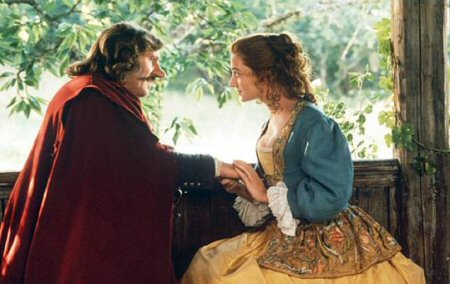
The movie permits children to work through a number of problems, including: whether the ugly and disfigured can still exist loved by someone who is cute; the humiliation and lack of self-esteem felt past people who are disfigured or who don't conform to society's electric current conception of dazzler or fashion; how the about vociferous braggart is oftentimes trying to cover up a deep psychological wound; the consequences of declining to pursue your dreams or of assuming that someone or something is unattainable; and the differences between how people view and evaluate themselves and how they are viewed and evaluated by others.
"Cyrano de Bergerac" repeatedly and effectively employs irony. The Give-and-take Questions gear up out below volition help teachers and parents to explore this consequence.
POSSIBLE PROBLEMS
PARENTING POINTS
Should your kid be reading Cyrano de Bergerac in either a French or English class, y'all may want to show this film. It is an excellent adaptation that vividly communicates the tragic aspects of the story through superb interim. Later, you lot may propose that your child spotter the delightful Steve Martin comedy, Roxanne , which echoes the storyline and theme just ends on a happy Hollywood notation. Thus, your child volition come across that, although written long ago, the ideas in the play still take relevance.
Discussion Questions #8 contains helpful information about the psychology of bullies. The Quick Discussion Question captures an of import theme of the play, a theme which will resonate with any boyish.
HELPFUL Groundwork
The Cyrano of this play was based on a real person, Savinien Cyrano de Bergerac (1619 – 1655), a French duelist and satirist. De Bergerac is quoted as having said:
"A large nose is the marker of a witty, courteous, affable, generous, and liberal homo."
Cyrano de Bergerac was born in 1619 in Perigord, a province in southwest French republic. He was the subject of ridicule past children his own historic period due to his very big nose. De Bergerac joined the French army and fought against the Castilian at Arras. He left the armed services in 1642 to study science and literature in Paris. He besides wrote plays and novels of scientific discipline fiction. De Bergerac was hit by a "falling log" which, as in the play, was rumored to have been set in motion past his enemies. He died a year later.
In that location are three dissimilar types of irony. Each relates to a divergence between what is perceived or expected and what occurs. The different types of irony are described below:
(1) Situational irony occurs when there is a deviation betwixt what happens and what nosotros expect to happen or what we think should happen. An example of situational irony in fiction is contained in the story of the frog who, when kissed by the princess, becomes a handsome prince. We do not await that kissing an ugly slimy matter that lives in a swamp and eats flies volition bring forth a beautiful swain. In fiction, irony ordinarily points to a theme or moral in the story. Situational irony is oftentimes used in comedy and satire because, when skillfully used, it quickly exposes the truth.
Situational irony can also exist in the existent globe. For example, the United States is a nation founded on the proffer that ". . . [A]ll men are created equal, that they are endowed by their Creator with certain unalienable Rights, that amid these are Life, Liberty and the pursuit of Happiness . . . ." Even so, while the Founding Fathers of the U.Due south. were brilliant and wise men who were right on many things, they dropped the ball on slavery. In fact, the very existence of the United States depended on a bargain struck at the Continental Congress in 1776 between the representatives of the Northern colonies and the men from the Southern colonies. They agreed that slavery, which resulted in millions of people existence denied the right to "life, liberty and the pursuit of happiness", would be allowed to flourish in the South. At the fourth dimension of the American Revolution, Southern colonists correctly foresaw that Groovy Britain would presently ban slavery in all of its colonies. Many Southern colonists were willing to risk a revolution confronting what was then the most powerful empire on Globe, only if they were assured that they could retain slavery in the new country. This situation is ironic considering one would not expect a nation founded on the principles of the Announcement of Independence to owe its existence to a bargain that ensured the slavery of millions for the foreseeable future. [There are multiple examples of situational irony in the history of every country. Teachers in countries other than the U.S. should substitute an case of situational irony in their own history.]
(two) In a work of fiction, dramatic irony occurs when an author creates a dissimilarity between the reality perceived by one or more of the characters and what is known by the audition or the reader. This happens when the audience/reader has greater knowledge virtually present or futurity circumstances than the characters in the story. The classic example of dramatic irony is contained in Oedipus Rex. Oedipus kills a homo who is a stranger to him and and then meets and marries the dead man'southward widow. The audience knows that the expressionless human is Oedipus' father and that his new wife is his mother. Merely later on does Oedipus larn these facts, with tragic results. As with situational irony, dramatic irony usually points to a theme or moral lesson.
(3) An ironic statement is one in which at that place is a significant difference between what is said and what is meant. It occurs when the speaker doesn't intend to convey the literal meaning of the words used, only instead means something quite different. Often the meaning is the opposite of the literal meaning of the words. Ironic statements can be either "facetious" or "sarcastic". A facetious comment is one in which the bespeak is to make a joke or a humorous reference. Sarcasm is used to taunt, insult, or cause pain. Facetious statements and sarcasm are often very similar. The identity of the speaker, the tone used, and the context can determine whether a statement is facetious or sarcastic. A person who likes a lot of sugar with their java might say, facetiously, "I like a niggling coffee with my sugar" as he pours an astounding amount of sugar into a cup of java. However, a person who wanted to taunt the coffee drinker would say, "You like a piddling java with your carbohydrate, don't y'all."
Irony is cardinal to the appeal of "Cyrano de Bergerac." It starts at the cadre of the play and radiates outward in all directions. The underlying irony is that while Cyrano is ugly on the exterior, on the inside he has many attributes that we admire: courage (in almost areas), kindness, a championing the underdog, loyalty, and love of justice and dazzler.
Other examples of irony in this play are every bit follows:
- Christian, in contrast to Cyrano, looks beautiful but when he opens his mouth what comes out is far from beautiful.
- Roxane is attracted to Christian for his looks but comes to really love him because of the cute words and images written past Cyrano, a physically unattractive person.
- Cyrano is fearless in almost situations and is accounted by those who know him to be afraid of cypher, but in regards to the most of import thing in his life, his love for Roxane, his abject fright of rejection prevents him from interim to attain his goal.
- Cyrano claims at the end of his life that he will be remembered for his "panache" ("dash, flamboyance, distinctive and stylish elegance"). But Cyrano is a man with a deformity in the middle of his face who is then agape of rejection past a immature girl (Roxane) that he misses the chief adventure for happiness in his life.
- Cyrano insists that everyone else appear to ignore his olfactory organ but thereby keeps the consciousness of information technology in everyone's mind, nor tin can he forget it for a moment.
- Cyrano makes strenuous efforts to make upwards for his deformity and ugliness by his devotion to poetry, his skill at fencing, and his championship of the underdog. Yet he didn't even try for something that meant more to him than anything else, i.e. Roxane.
Word QUESTIONS
1. Standard Questions Suitable for Any Movie .
No Suggested Answers.
two. Define the literary device of irony and depict three ironic situations in this play.
Suggested Response:
Encounter Section on Irony in theHelpful Groundwork section.
3. At the terminate of the play, just before Cyrano died, he said of himself, "… [H]e will be remembered for … what? His heart? Courage? No, of course not. Nothing half and then commonplace: For his panache." What did Cyrano mean by "panache?" Why is Cyrano'due south devotion to "panache" an case of irony on at least two levels?
Suggested Response:
Nosotros tin can think of several. Get-go, Cyrano's olfactory organ was kind of his panache, it stuck out from his head every bit a panache would stick out from a helmet. Second, a person with panache is not more often than not thought of as being afraid to declare his beloved to a woman. Third, a brio is made of feathers, a thing of light and blusterous beauty; Cyrano was far from that.
iv. In this picture, Cyrano, who is put forward as a human who tin practise near anything, is a man without requited love. Is this another example of irony? Why?
Suggested Response:
Yes. Cyrano can practice anything but the matter he needs to exercise the most, pursue his dear involvement with Roxane.
5. What is ironic almost the differences betwixt Cyrano and Christian?
Suggested Response:
Cyrano is ugly to look at but beautiful to heed to. Christian is just the opposite.
half-dozen. Henrik Ibsen, the great Norwegian playwright, is reported to accept said: "If you put a pistol on phase in Act I, yous must utilize it past the end of Act V?" That is truthful of this play. What is the "pistol" in "Cyrano de Bergerac?"
Suggested Response:
The fact that Cyrano was hated and resented by many others. At the end of the play, they have killed him. Another way of putting this is that Cyrano was unable to restrain his sarcasm and kept insulting and assaulting people. This is the gun. Inevitably, those insulted would strike back.
7. What qualities of Cyrano do you admire and what qualities would y'all go out backside?
Suggested Response:
At that place is no one correct answer to this question. He was courageous (in nearly areas), kind, a champion of the underdog, loyal, and a lover of justice and beauty. One can adore his skill as a poet, swordsman and soldier. Ane might not adore his snobbishness and insensitivity; his tendency to resort to violence, his obsession with his nose, and his cowardice in the face up of Roxane.
8. Many people believe that bullies are, similar Cyrano, roofing upwards some insecurity or sense of vulnerability. This is incorrect. Psychological studies find that about bullies "meet themselves quite positively" and are unaware of what others actually think of them. What makes well-nigh bullies starts in early childhood. They have ingrained patterns of using assailment and hostility in their relationships with other people. A feeling of insecurity is only ane of many things that can trigger a hostile or trigger-happy response from a peachy. In fact, no trigger is necessary for a bully to exist hostile or aggressive. To solve conflicts and get along in life, bullies rely on assailment and the fear and power that their aggression creates. They have difficulty relating to people on other levels. Marano, H.E., Large Bad Bully Psychology Today. Why do many people think that bullies are roofing upward for feelings of insecurity and vulnerability?
Suggested Response:
The idea that bullying behavior arises from feelings of insecurity comes from the efforts of normal people to understand what makes a bully. When most people recollect about this question they utilise the context of their ain, more normal personalities. For them, covering feelings of insecurity by lashing out at others is a natural, if dysfunctional, response. Notwithstanding, bullies don't meet the globe that way. For them, aggression, violence and hostility in human relations are the norm. Come across also TWM's Snippet Lesson Plan to the Psychology of Bullies Using "17 Once more".
SOCIAL-EMOTIONAL LEARNING
Self-ESTEEM
i. Cyrano gave the impression of being a proud homo with a lot of self-esteem. Only did he really accept self-esteem?
Suggested Response:
No. He couldn't get over his olfactory organ.
2. Cyrano insisted that everyone else appear to ignore the size of his olfactory organ and however, in his heart, he believed that everyone thought it to exist his nigh remarkable feature. (Certainly, he himself never forgot virtually information technology except maybe when he was caught up in reciting verse or out-fencing those he wanted to humiliate.) What does this fact tell u.s.a. about Cyrano's graphic symbol?
Suggested Response:
At that place are many ways to express an reply. Good answers will refer, in one way or some other, to his low cocky-esteem.
iii. What if Cyrano had been a woman? Could a tragic figure be created out of a woman with a deformity on her face? What does this tell us about our society and our own reactions to men and women?
Suggested Response:
We don't know the answer to this question but it volition provide some excellent class discussions. Note that there are differences between the answer for Cyrano'south time and for the 1950s in the U.South. and for the present day in the U.S.
4. The opinion leaders in our order value physical fitness and a effigy for a woman that is without actress weight but has large breasts and small hips. In other centuries plump women were considered the ideal beauties. In other cultures in our own time, for case in Brazil, women with modest breasts and large hips are considered more bonny than women with big breasts and small hips. What does this tell you near beauty?
Suggested Response:
That the platonic body type or shape of face up is, in many means, like a fad. It changes for no reason. This play tells us that beauty is skin deep. Cyrano was, in many ways, a more than interesting and cute person than Christian.
ROMANTIC RELATIONSHIPS
5. All that Cyrano had to do in order to find the beloved he desired so much was to declare himself to Roxane and woo her with his words. Compared to many of Cyrano'southward other accomplishments, could this have been hands done? What does this tell you near how to live your own life?
Suggested Response:
Cyrano needed to take a risk. His fearfulness immobilized him. Someone once said that our fears are all lies. While this may go a little besides far, it is truthful for many, if not well-nigh of our fears.
6. Cyrano was a mettlesome soldier and fighter, a man of activeness who took incredible risks. Still he was afraid to take activeness in the one area that would accept made him happy? Why was this?
Suggested Response:
1 can be courageous in some areas and paralyzed by fright in others.
7. Why couldn't Roxane have signaled to Cyrano that she was in beloved with him?
Suggested Response:
The respond is that she should have.
MORAL-Upstanding Accent (CHARACTER COUNTS)
Discussion Questions Relating to Ethical Bug volition facilitate the utilise of this flick to teach upstanding principles and critical viewing. Additional questions are set out below.
RESPECT
(Treat others with respect; follow the Aureate Rule; Exist tolerant of differences; Utilize good manners, peachy language; Be considerate of the feelings of others; Don't threaten, hit or hurt anyone; Deal peacefully with acrimony, insults, and disagreements)
ane. Did Cyrano obey this Colonnade in any way?
Suggested Response:
Not really. He was not tolerant nor was he considerate of the feelings of others. Nor did he bargain peacefully with anger, insults or disagreements. He certainly threatened, hit and hurt.
2. What action did Cyrano demand of others that he was incapable of? Why?
Suggested Response:
He demanded that people respect him equally a person when he was incapable of respecting himself and showed little respect for others. He only couldn't go over the size of his nose.
ASSIGNMENTS, PROJECTS & ACTIVITIES
Acknowledgments: Thank you to Rebecca Curtis, an English language Professor at Santa Monica Higher,
for reviewing this Learning Guide. This Learning Guide was last updated on August 4, 2010.
Source: https://teachwithmovies.org/cyrano-de-bergerac/

Post a Comment for "Cyrano De Bergerac Listening Activities and Reading Activities"