I Think I Have Polyhydramnios Again
Overview
Polyhydramnios (politico-e-hi-DRAM-nee-os) is the excessive aggregating of amniotic fluid — the fluid that surrounds the baby in the uterus during pregnancy. Polyhydramnios occurs in almost one to ii percent of pregnancies.
Most cases of polyhydramnios are mild and result from a gradual buildup of amniotic fluid during the 2d one-half of pregnancy. Severe polyhydramnios may cause shortness of breath, preterm labor, or other signs and symptoms.
If you're diagnosed with polyhydramnios, your health care provider volition carefully monitor your pregnancy to aid forestall complications. Treatment depends on the severity of the condition. Mild polyhydramnios may go away on its own. Severe polyhydramnios may require closer monitoring.
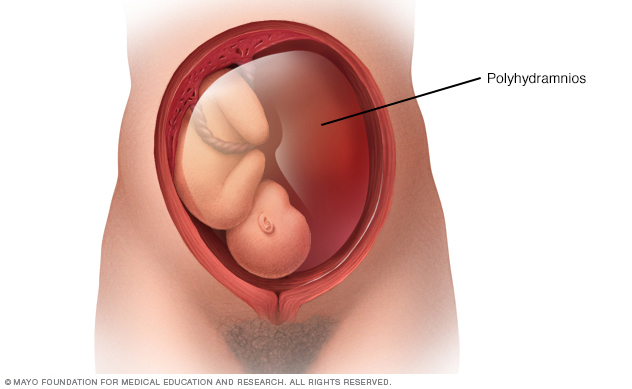
In polyhydramnios, excessive amniotic fluid accumulates in the uterus during pregnancy. Mild cases of polyhydramnios may go away on their own. Astringent cases may require treatment.
Symptoms
Polyhydramnios symptoms result from pressure level being exerted within the uterus and on nearby organs.
Mild polyhydramnios may cause few — if whatever — signs or symptoms. Severe polyhydramnios may cause:
- Shortness of jiff or the disability to breathe
- Swelling in the lower extremities and abdominal wall
- Uterine discomfort or contractions
- Fetal malposition, such every bit breech presentation
Your health care provider may as well suspect polyhydramnios if your uterus is excessively enlarged and he or she has problem feeling the baby.
Causes
Some of the known causes of polyhydramnios include:
- A nascency defect that affects the infant'southward gastrointestinal tract or central nervous organisation
- Maternal diabetes
- Twin-twin transfusion — a possible complication of identical twin pregnancies in which i twin receives too much claret and the other too little
- A lack of red blood cells in the baby (fetal anemia)
- Blood incompatibilities betwixt mother and infant
- Infection during pregnancy
Oftentimes, still, the cause of polyhydramnios isn't articulate.
Complications
Polyhydramnios is associated with:
- Premature birth
- Premature rupture of membranes — when your water breaks early on
- Placental abruption — when the placenta peels away from the inner wall of the uterus before delivery
- Umbilical cord prolapse — when the umbilical cord drops into the vagina alee of the baby
- C-department delivery
- Stillbirth
- Heavy bleeding due to lack of uterine muscle tone after commitment
The earlier that polyhydramnios occurs in pregnancy and the greater the amount of excess amniotic fluid, the higher the risk of complications.
Diagnosis
If your health care provider suspects polyhydramnios, he or she will exercise a fetal ultrasound. This test uses high-frequency sound waves to produce images of your infant on a monitor.
If the initial ultrasound shows evidence of polyhydramnios, your health intendance provider may do a more detailed ultrasound. He or she will estimate the amniotic fluid volume (AFV) past measuring the single largest, deepest pocket of fluid effectually your baby. An AFV value of 8 centimeters or more than suggests polyhydramnios.
An alternative way of measuring amniotic fluid is measuring the largest pocket in four specific parts of your uterus. The sum of these measurements is the amniotic fluid alphabetize (AFI). An AFI of 25 centimeters or more indicates polyhydramnios. Your health care provider will also use a detailed ultrasound to diagnose or rule out birth defects and other complications.
Your health care provider may offer boosted testing if y'all accept a diagnosis of polyhydramnios. Testing will be based on your chance factors, exposure to infections and prior evaluations of your babe. Boosted tests may include:
- Blood tests. Blood tests for infectious diseases associated with polyhydramnios may exist offered.
- Amniocentesis. Amniocentesis is a procedure in which a sample of amniotic fluid — which contains fetal cells and diverse chemicals produced by the baby — is removed from the uterus for testing. Testing may include a karyotype analysis, used to screen the baby's chromosomes for abnormalities.
If you're diagnosed with polyhydramnios, your health intendance provider will closely monitor your pregnancy. Monitoring may include the following:
- Nonstress test. This test checks how your babe'due south eye rate reacts when your baby moves. During the exam, you'll wearable a special device on your belly to mensurate the infant's eye rate. You may be asked to eat or drink something to make the baby active. A buzzer-like device also may be used to wake the babe and encourage motility.
- Biophysical profile. This test uses an ultrasound to provide more data virtually your baby'southward breathing, tone and movement, as well every bit the book of amniotic fluid in your uterus. It may be combined with a nonstress test.
Treatment
Balmy cases of polyhydramnios rarely require treatment and may go abroad on their own. Even cases that cause discomfort tin unremarkably be managed without intervention.
In other cases, treatment for an underlying condition — such as diabetes — may assistance resolve polyhydramnios.
If you feel preterm labor, shortness of breath or abdominal pain, y'all may demand treatment — potentially in the hospital. Treatment may include:
- Drainage of excess amniotic fluid. Your health intendance provider may use amniocentesis to drain excess amniotic fluid from your uterus. This procedure carries a minor risk of complications, including preterm labor, placental abruption and premature rupture of the membranes.
- Medication. Your wellness care provider may prescribe the oral medication indomethacin (Indocin) to help reduce fetal urine product and amniotic fluid book. Indomethacin isn't recommended across 31 weeks of pregnancy. Due to the gamble of fetal heart bug, your baby's center may need to be monitored with a fetal echocardiogram and Doppler ultrasound. Other side effects may include nausea, vomiting, acrid reflux and inflammation of the lining of the breadbasket (gastritis).
After handling, your doctor will all the same want to monitor your amniotic fluid level approximately every ane to three weeks.
If you have mild to moderate polyhydramnios, you'll likely be able to carry your baby to term, delivering at 39 or forty weeks. If you lot have severe polyhydramnios, your health intendance provider will discuss the appropriate timing of delivery, to avoid complications for y'all and your babe.
Polyhydramnios tin can be a worrisome finding during pregnancy. Work with your pregnancy care provider to ensure that you and your baby receive the best possible intendance.
Preparing for an date
You're likely to start past talking with your pregnancy intendance provider. Here'due south some information to help you get set for your date and what to wait from your doctor.
What you tin exercise
Before your date:
- Write down any symptoms yous're experiencing, including when they first started and how they've inverse over time.
- Write down key personal information, including any other medical conditions for which you're existence treated.
- Brand a listing of all medications, vitamins or supplements that y'all're taking.
- Ask a friend or family unit member to accompany you, if possible, to your date. Having someone else at that place may help you remember something that you forgot or missed.
- Write down questions to ask your physician.
Preparing a list of questions will help y'all make the almost of your fourth dimension with your physician. For polyhydramnios, some basic questions to enquire include:
- What kind of tests do I need? How soon exercise I need to be tested?
- What treatment arroyo do you recommend?
- Exercise I need to follow any activity restrictions?
- What emergency signs and symptoms should I watch for at home?
- How could this status bear on my baby?
- If I get pregnant again, volition this happen again?
- Do yous have whatever printed information that I tin take with me? What websites practice you recommend for more information?
What to expect from your dr.
Your dr. will likely perform a concrete examination and run some tests, including an ultrasound exam. He or she may also ask you a number of questions, such as:
- When did y'all first begin experiencing symptoms?
- Take your symptoms been continuous or occasional?
- Practise you have shortness of jiff?
- Are you experiencing any lightheadedness or dizziness?
- Have y'all noticed an increase in swelling? Does it seem like you're retaining more fluid than usual?
- What, if annihilation, seems to make your symptoms better?
- What, if annihilation, appears to worsen your symptoms?
© 2022 Mayo Foundation for Medical Teaching and Research (MFMER). All rights reserved. Terms of Use
Source: https://middlesexhealth.org/learning-center/diseases-and-conditions/polyhydramnios
Post a Comment for "I Think I Have Polyhydramnios Again"